Welcoming a baby through surrogacy is often accompanied by a deeply human mix of love, anticipation, and adjustment. And while every story is unique, one question frequently arises during those first few weeks:
How can we help our baby feel safe, secure, and regulated from the very beginning — especially after an early transition between different wombs, voices, and arms?
Developmental neuroscience has begun to answer this question with something fascinating: babies are not only born ready to eat or sleep. They are also born seeking sensory continuity.
In other words, they look for familiar signals that tell their nervous system the world is safe. For babies born through surrogacy, this transition can be especially significant. For months, the baby became familiar with a specific heartbeat, a predominant voice, particular hormonal patterns, and even certain scents inside the womb. After birth, the environmental shift can feel more abrupt than in other circumstances.
The good news is that the neonatal brain has an extraordinary capacity to adapt when it encounters consistent experiences of regulation and that is where a thoughtfully designed sensory continuity approach becomes so valuable.
Sleep doesn’t begin in the crib — it begins in the nervous system
During the first months of life, sleep is not driven solely by physical tiredness. It is deeply connected to a baby’s sense of safety.
Research in early neurodevelopment shows that babies regulate their heart rate, breathing, and cortisol levels through co-regulation with the adults who care for them.
When a baby experiences consistent signals — a familiar voice, skin-to-skin contact, predictable rhythmic patterns, or soft recognizable scents — the nervous system lowers its state of alertness, making deeper transitions into sleep easier.
The sensory continuity approach
The goal is not to “train” a baby to sleep.
The goal is to create a coherent sensory experience that helps the neonatal brain recognize safety.
1. Layers of scent: olfactory memory and emotional safety
The sense of smell is one of the most developed neurological systems at birth.
In fact, studies published in Pediatrics and Frontiers in Psychology have shown that newborns can recognize familiar scents associated with their prenatal environment, and that these stimuli may influence emotional regulation and early sleep patterns.
In surrogacy journeys, scent layering can become a powerful transitional tool.
How to implement it
- Use a soft blanket or fabric carrying the natural scent of the home where the baby will live.
- Avoid heavily scented detergents during the first few weeks.
- Gradually introduce soft, consistent scents into the nighttime routine.
- Maintain the same light ambient fragrance whenever possible (always newborn-safe and free from harsh chemicals).
The key is not stimulation — it is familiarity.
2. Vocal resonance: the neurological power of the human voice
Before birth, babies hear.
And not only do they hear — they memorize patterns.
Multiple studies in perinatal neuroscience show that newborns recognize voices they heard repeatedly during pregnancy, especially rhythmic tones and prosodic speech patterns.
That is why, in surrogacy experiences, intentional vocal preparation before birth can be incredibly meaningful.
The goal is not simply to “talk more” to the baby.
The goal is to create auditory continuity.
Recommended practices
- Record readings, lullabies, or spoken messages during pregnancy.
- Use the same bedtime song during the first few weeks.
- Speak slowly before sleep using calm, low, steady tones.
- Repeat short, consistent phrases as part of every nighttime routine.
The neonatal brain finds regulation in predictability.
And few things are as predictable as a loving voice returning night after night in the same gentle way.
3. Co-regulation: the true foundation of early sleep
One of the most important concepts in modern infant neuroscience is this:
Babies do not learn to self-regulate on their own first.
They first learn regulation through us.
Co-regulation occurs when an adult’s nervous system helps the baby find physiological and emotional stability.
This includes:
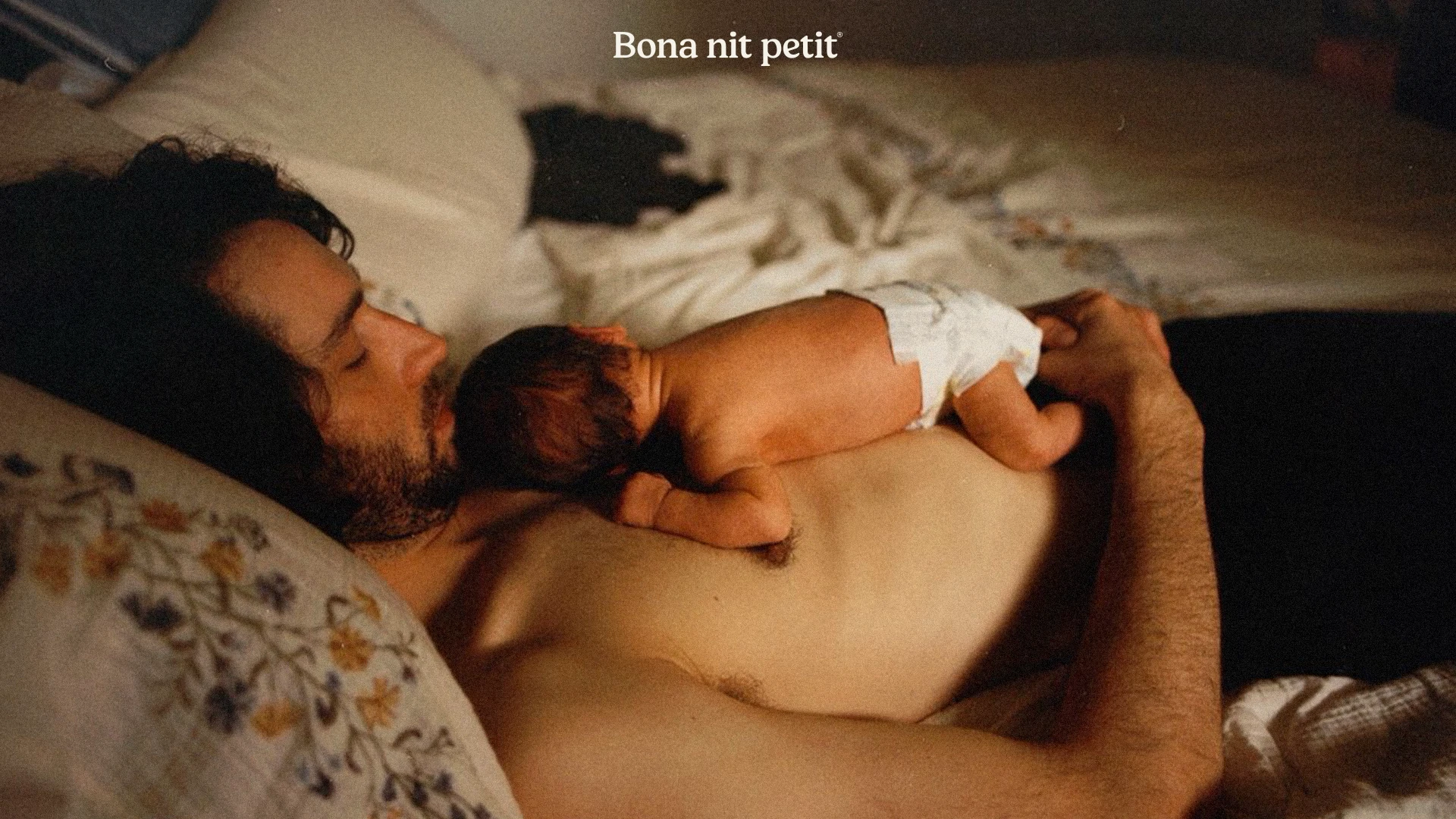
- skin-to-skin contact
- synchronized breathing
- rhythmic rocking
- soft eye contact
- stable temperature
- responsive care when the baby cries
The American Academy of Pediatrics has strongly supported practices such as skin-to-skin contact and responsive caregiving during the neonatal period because of their physiological and emotional benefits.
For babies born through surrogacy, this stage should not be seen as “overcompensating.”
It should be understood as the building of secure attachment.
What a sensory continuity bedtime routine can look like in practice
It does not need to be complicated. In fact, the simpler and more consistent it is, the better.
Example of a regulating nighttime routine
60 minutes before bedtime
- Dim the lights throughout the home.
- Reduce visual and auditory stimulation.
- Maintain a stable room temperature.
30 minutes before bedtime
- Skin-to-skin contact.
- Gentle, repetitive vocal interaction.
- Introduce the same light ambient scent.
At sleep time
- Slow rocking or gentle vestibular movement.
- Predictable continuous sound (voice, song, or moderate white noise).
- A gradual transition into the crib without abrupt changes in temperature or sound.
It is the repetition of consistency, night after night, that ultimately builds neurological safety.
Most importantly: this is not about perfection
Many families enter the postpartum period believing they need to “do everything right” in order for the baby to sleep well.But the infant nervous system is not searching for perfection.
It is searching for connection.
For predictability.
For emotionally present caregivers.
Sensory continuity does not replace bonding — it supports it.
And in surrogacy experiences, it can become a deeply loving bridge between the world the baby knew before birth and the home they are now beginning to recognize as their own.
A new way of understanding infant sleep
Perhaps the question was never:
“How do we get the baby to sleep?”
Perhaps the real question is:
“How do we help the baby feel safe?”
Because when the nervous system experiences safety, sleep no longer feels like separation.
It begins to feel like rest.